Rede
Published on
Reading Time
8 mins
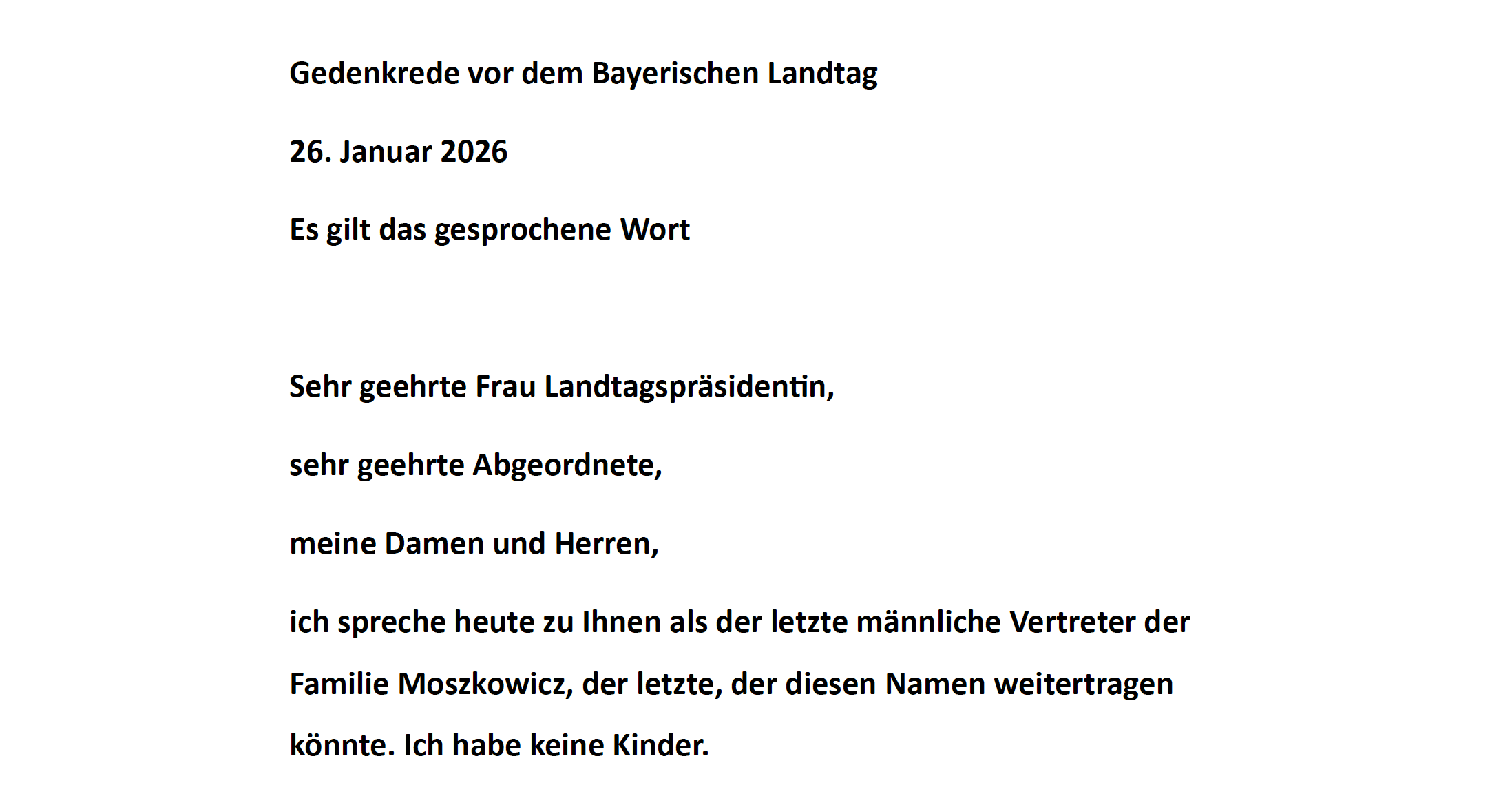
Madam President of the State Parliament,
Honorable Members of Parliament,
Ladies and Gentlemen,
I speak to you today as the last male representative of the Moszkowicz family, the last who could carry on this name. I have no children.
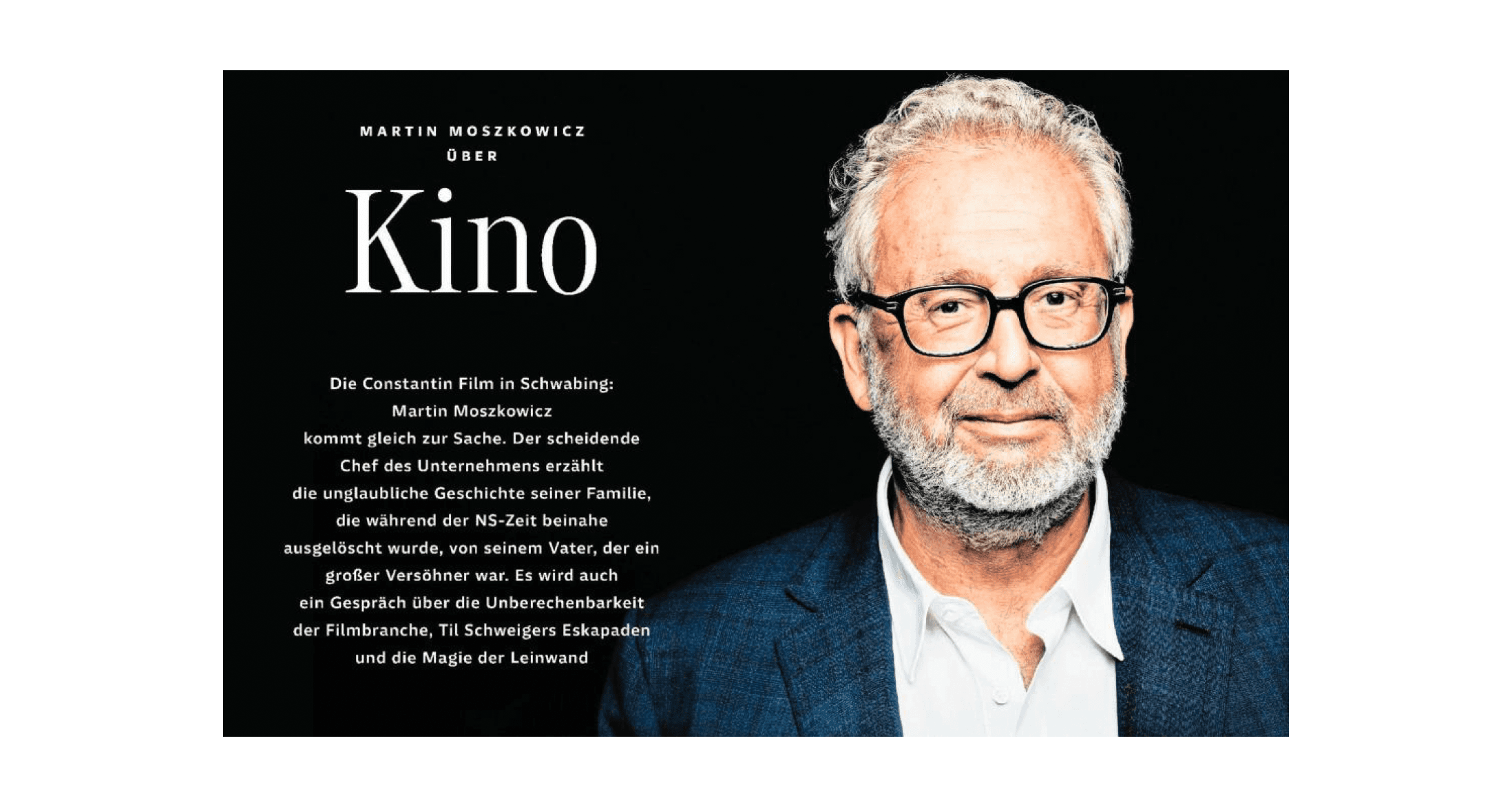
With me, this name, which once resounded in the streets of the small Westphalian town of Ahlen, which was branded by the hell of Auschwitz and which stood for hope for reconciliation in the post-war period, will fall silent forever. This loss, the absence of my murdered relatives and the knowledge that our line has come to an end, is not a historical footnote for me. I feel this loss constantly and always. It sets the pace of my life. My sister Daniela regularly talks about our parents’ lives in schools.
My father, Imo Moszkowicz, was born into poverty in the mining town of Ahlen, which had a population of 25,000. He was one of seven siblings. His father was a shoemaker who often worked for free because his customers—poor miners—had nothing themselves. His childhood was marked by deprivation, but also by a deep sense of solidarity. The small Jewish community of around 130 members came under increasing pressure after January 30, 1933. But this world collapsed on November 9, 1938.
With the start of the pogrom nights, the SA stormed the family home, destroying the furnishings and the neighboring synagogue. My father had to watch as his brothers were beaten with rubber truncheons and his teacher had to seek refuge in the hospital. After various stops and five years later, in 1943, deportation to Auschwitz followed.
There he became number 104998. He survived the murderous work in the cement commando for IG Farben. He survived only thanks to an almost unbelievable event: when he had already been selected for the gas chamber because of severe purulent abscesses, a fellow prisoner named Gustl Herzog saved him. Herzog, a so-called “honorary prisoner,” crossed Imo’s number off the death list and put that of a dying Greek man on it instead. From then on, my father lived with the certainty that a stranger had died in his place—a burden he carried throughout his life like an invisible bond to this unknown man.
His mother and siblings were killed in the extermination camps.
The fact that I am able to speak to you here today is thanks to another series of miracles. My father survived the murderous death marches from Auschwitz to the west. He was liberated in Liberec, Czech Republic, not far from here, and encountered an advance party of American soldiers—a unit trained in caring for former concentration camp prisoners. About 20 years ago, I managed to track down one of these two liberators. He was living in a retirement home in upstate New York. When I stood before him, this elderly man remembered the “young Imo.” He told me how he and his platoon wanted to take Imo to Paris to fly with them to Wisconsin from there. My father was already on that train. But when the train happened to pass through Ahlen on its necessary detours through devastated Germany, he saw the familiar outlines of his city. He didn’t hesitate, took his suitcase, and jumped off the train. He said, “I’m home.” Without that leap from the train, without that courage to return home despite everything, I would not be here today.
My parents’ story is one of the most extraordinary stories of reconciliation of our time. They met in Buenos Aires. My father had traveled there in early 1952 to search for his father, my grandfather, who had emigrated in 1938 shortly before the November pogroms in order to bring his family to Argentina. My mother Renate, on the other hand, had followed her father – Armin Dadieu, the former SS Gauhauptmann of the Ostmark and wanted war criminal, who had fled from Austria to Argentina via the so-called “Rat Line.”
They met at a motley gathering in Buenos Aires, a city where former persecutors and fugitive Nazi leaders came together. In this bizarre and tense atmosphere, the impossible happened: they fell in love. My father did not see my mother as the daughter of the system that had destroyed his family. He saw the person. My parents became architects of a reconciliation that went far beyond the imaginable. My father later even maintained a polite relationship with his father-in-law, the former high-ranking SS officer, because he refused to place the sins of the fathers above the humanity of the present.
My father remained deeply attached to German culture. He was not displaced in spirit; he was a preserver. He loved the classics; Goethe and Schiller were his constant companions. He knew Faust by heart. Even in the camp, he recited the “Prologue in Heaven” while corpses were piled up around him. This language was his home, a home that he did not allow the murderers to rob him of. After the war, he first became an assistant director to Gustav Gründgens and then a director himself.
My sister and I are often asked why my father did not testify as a witness at the major Auschwitz trials in Frankfurt in 1963. The answer lies in the deep disappointment he felt in the first years after his return. When he came to Ahlen in 1945, he sought justice. But he often found only coldness. The people in his hometown did not want to be reminded of the past. When he tried to name the murderers of his family and the informers, he was met with hostility.
They didn’t want the “Jewish troublemaker.” This experience of rejection by the neighbors with whom he had once lived next door hurt him more deeply than the whip in the camp. He decided not to recount his story in German courts, where he would once again have to feel like a supplicant. He gave his testimony on stage. His productions were his statements to world history.
However, he had to experience that the hatred never completely disappeared. In the 1980s, he protested against an SS meeting in Bad Hersfeld, where he was directing. The result was threatening letters—at that time still in paper form—that followed him all the way to us. His credo was marked by a sad realism: he said that anti-Semitism had always existed and that one was powerless against it. For him, who had experienced the extreme, it was already a victory “if Jews were not killed.” That was his modest, almost desperate yardstick for security.
I would like to say something here that is important to me—precisely because it contradicts the temptation to simplify history. The city of Ahlen, where my family lived, where my father was humiliated, expelled, and robbed of his childhood, has faced up to its responsibility in an extraordinary way over the past decades. Since the early 1980s, the city, civil society, the local adult education center, schools, and initiatives have worked intensively and seriously for many years to address the injustice done to my family and other Jewish families.
There was no defensiveness, no relativization, no “drawing a line under it.” Instead, a distinctive culture of remembrance emerged: through research, memorial sites, educational work, and personal encounters. This commitment was not symbolic or ritualized. It was sincere and it was not a matter of course. And that was the reason why my father accepted the city’s offer of “honorary citizenship” in March 2006! He was a man of reconciliation! For me, this is of great significance. It shows that remembrance is not just about managing guilt, but also an active process of lived and experienced responsibility. That a city, a community, can say decades later: We see what happened. We face up to it. And we draw conclusions for our actions today. Reconciliation is not a fixed state. It is a daily decision. Ahlen has made this decision – and that deserves recognition.
Today, ladies and gentlemen, we must ask ourselves: Should “not being killed” be our standard? We are currently experiencing a situation that would have deeply shaken my father. Anti-Semitism is everywhere again and stronger than ever since the Shoah and World War II – and it is more overt than ever. Today, it no longer comes only from the fringes. It is fueled by three forces that are strangely united in their hatred of Jews:
First, from the right, where people want to reinterpret history and dispose of memory.
Second, from the left, where ancient anti-Semitic stereotypes are being used under the guise of the “postcolonialism debate” and supposed “criticism of Israel.”
And thirdly, through radical Islamism and anti-Zionism, imported from the Middle East, which openly spreads its hatred on our streets.
In addition to these three clearly recognizable sources of anti-Semitism, however, there is a fourth area that is rarely discussed—and which causes me at least as much concern. It is the large proportion of our fellow citizens who are indifferent or undecided on the issue. People who are not consciously anti-Semitic. People who see themselves as tolerant, liberal, or simply apolitical. People who say, “I don’t have an opinion on that.”
This initial stance may seem convenient. It may be perceived as an expression of neutrality. In reality, however, it is the opposite. For anti-Semitism—both historically and in the present day—thrives not only on hatred, but also on turning a blind eye, on silence, on the desire to avoid taking a stand.
And to the politicians here in this chamber: for three months, a petition with clear proposals for action has been lying with the Bundestag in Berlin – so far without response. Please help here!
My family did not only suffer at the hands of the perpetrators. It also suffered from the passivity of the many who did nothing, who looked away out of fear or opportunism. Those who did not want to know. Those who thought it was none of their business. “Suffered” is the wrong word, ladies and gentlemen, because my family is still suffering today. But not only my family, but every decent person who rejects the anti-Semitic spirit of the times. History shows us time and again that the most dangerous ally of hatred is not the radical, but the indifferent.
That is precisely why remembrance is not only directed against extremism. It is directed at the center of society. It demands a stance—not outrage, but a sense of responsibility. Not words, but deeds.
Anti-Semitism thrives on the hatred of the few—and the silence of the many. Today, we are seeing a number of anti-Semitic attacks and assaults that we have never seen before in this intensity in the Federal Republic. Unfortunately, this is not only happening in Germany, but worldwide.
But let us stay here. Jews in Germany feel this change every day. It is the uneasy feeling when wearing a kippah, the fear of sending children to Jewish kindergartens, which – just like synagogues – have to be guarded by police with submachine guns. We are experiencing a creeping normalization of hatred that we must never accept.
In this context, let me also say a few clear words about Israel. I criticize many decisions made by the current Israeli government—just as hundreds of thousands of Israelis do every week on the streets of Tel Aviv. Criticizing a government is the highest form of democracy. But what we are witnessing today is something else. This is not criticism of politics; this is questioning the right of a state to exist. For Jews, Israel is not just any country. It is the life insurance that my father and his six siblings did not have. Anyone who attacks Israel’s right to exist attacks the security of every single Jew worldwide. That is non-negotiable. Never.
Some may wonder why we still need to commemorate the liberation of Auschwitz 81 years ago today. Why we keep revisiting a past that seems so distant. The answer is simple—and uncomfortable: because what happened back then is not over. It is not history in the museum sense. It is a benchmark. A touchstone for our present. Remembrance is not a backward-looking exercise. It is a form of political and moral vigilance. It reminds us how quickly a society loses its values when people are dehumanized – first linguistically, then socially, then physically.
My father survived Auschwitz. But he never believed that history could not repeat itself. He knew that it does not begin with camps. It begins with words. With exclusion. With relativization. With the desire to finally not have to talk about it anymore. Remembrance does not protect the past. It protects the future. It is not a ritual for the dead alone, but an obligation to the living – and to those who are yet to come.
I conclude in memory of the victims. I remember my grandmother, my aunts and uncles, whose faces I know only from a few yellowed photos. I remember the millions who no longer have a voice.
But I am standing here above all as a warning. We have an obligation to the future. When I, as the last member of the Moszkowicz family, pass away, the memory of what was must not die with me. We must be a society in which Jewish life is not merely “tolerated” or “not killed,” but in which it is a natural, proud, and secure part of our shared identity.
My father jumped off the train back then because he believed in Germany as a country of culture and moral tolerance—despite everything. Let us work together to ensure that this belief was not in vain. Let us first ensure that no one has to be afraid of being “at home” in this country anymore. Although I am not impartial as his son, I believe that my father and mother are role models in this regard.
Thank you very much.